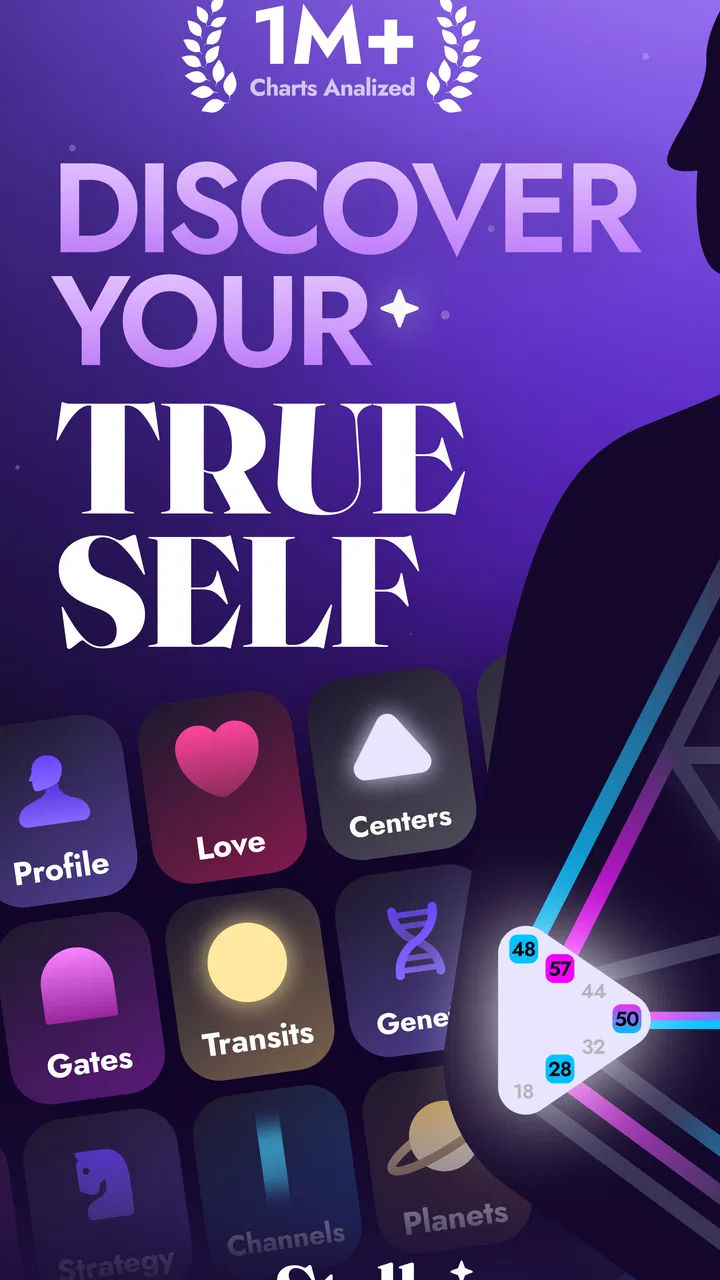
Human Design: Stella
- 4.6
- Rating
- 500.00K
- Installs
- Free
- Price

 Analysis by App-foxy
I approached Human Design: Stella as a lifestyle app rather than a quick entertainment download. Its purpose is to help people explore Human Design and use that framework for personal reflection. That immediately makes the experience different from a habit tracker, meditation timer, or general horoscope app: the value depends less on constant interaction and more on whether you enjoy studying an interpretive system and relating it to everyday decisions.
My first impression is that Stella is best understood as a guided self-discovery tool. It gives curious users a place to return to when they want to think about their tendencies, choices, relationships, and routines. I would not treat its interpretations as medical, psychological, or scientific advice, but I can see why someone might find the framework useful for journaling and structured self-observation. The strongest way to use it is as a prompt for reflection, not as a rulebook for living.
How Human Design: Stella feels in everyday use
I find Stella most useful when I arrive with one real-life question instead of expecting the app to explain everything at once. A brief visit can help me frame what I want to notice, while the more meaningful work happens afterward: comparing an idea with what I actually did and felt. That distinction also makes trust worth considering, especially when an app becomes part of personal reflection.
You May Also Like

 Blood Strike: 2.5 Anniversary
Blood Strike’s Loadouts Turn Every Drop Into a Tactical Gamble
A close look at Blood Strike’s custom loadouts: how fast access to signature weapons reshapes its battle royale rhythm, rewards preparation, and narrows the gap between fights.

 Pandora - Music & Podcasts
Pandora’s Music Is Easy to Start, but Harder to Recover
Pandora’s strength is its low-effort path from a seed to a station. Its weak spot is how much confidence it asks you to place in connection, setup, and quiet recovery.

 8 Ball Pool
 Is Built on Rivalries, Rematches, and Routine
A close look at the rivalries, rematches, shared routines, and unanswered safety questions that turn a quick pool match into a persistent mobile community.

 Samsung Music
’s Quiet Strength Is Playing What You Already Own
Its reach comes less from spectacle than from dependable access to a personal library. That simplicity is both the app’s strongest retention engine and its ceiling.

 AccuWeather: Weather Radar
AccuWeather Review: A Quick, Clear Forecast for Everyday Decisions
For everyday plans, the best forecast is the one you can understand quickly. AccuWeather makes rain timing, radar, and local conditions easy to act on, with a few trade-offs.

 Hill Climb Racing
Why Hill Climb Racing Still Turns Crashes Into One More Run
A tiny car, a bumpy hill and one more upgrade: Hill Climb Racing keeps resurfacing because its simple chaos makes every near-miss feel personal.
More From Our News Desk
View All News


A calm starting point for people new to Human Design
For a newcomer, the main challenge with Human Design is usually not opening an app; it is understanding what the terminology means and deciding which parts are personally useful. Stella’s focus gives the subject a more approachable home than searching through disconnected articles, videos, and social posts. Instead of treating the topic as a passing trend, I found the app’s appeal comes from giving the user a reason to return and build familiarity gradually.
That gradual approach matters. Someone who expects a single screen to reveal a complete answer about their personality may feel disappointed. Human Design involves concepts that can take time to absorb, and the most rewarding sessions are likely to be the ones where I read a section, connect it with a real situation, and then leave the app to think about it. The app works better as a companion to curiosity than as a one-minute verdict generator.
The store summary describes the experience as discovering your true self through Human Design, but I would interpret that promise carefully. No app can define a person completely. Stella can offer language and themes for self-examination, yet I remain responsible for deciding whether an interpretation fits my experience. That distinction makes the app more useful and prevents the common mistake of handing over too much authority to any personality-based system.
Speed expectations and the rhythm of a session
In practical terms, this is not the kind of app where speed is measured by rapid scrolling or constant live interaction. The important question is whether it gets me to relevant information without making the process feel confusing. For short visits, I would expect the experience to feel most satisfying when I already know what I want to explore, such as a recurring decision pattern or a relationship question.
Longer sessions need a different mindset. Reading reflective material takes more attention than checking a notification, so the app may feel slower simply because the subject asks me to pause. That is not necessarily a technical weakness. It is part of the trade-off: Stella encourages interpretation and thought, while a simple quote app provides instant consumption with much less depth.
A useful routine is to avoid opening it whenever I feel uncertain and asking it to make the decision for me. Instead, I would choose one question before opening the app, read with that question in mind, and write down what feels relevant afterward. This reduces aimless browsing and makes the app feel more responsive because I am using its material with a clear purpose.
What happens during heavier or repeated use
Heavy use here is less about demanding graphics and more about repeated reading, revisiting personal material, and comparing insights over time. A person who becomes deeply interested in Human Design may open Stella often, especially during periods of change. The benefit is continuity: the app can become a personal reference point instead of a one-off novelty.
The trade-off is mental overload. If I keep consuming interpretations without checking them against real behavior, the experience can turn into endless categorizing. I would avoid reading several sections in one sitting merely to collect labels. A better workflow is to focus on one theme, note a concrete example from the day, and return later to see whether the idea still feels useful. That is a more disciplined use than treating every description as equally important.
Another practical insight is to separate reflection from urgent action. If I am deciding whether to accept a job, end a relationship, or change a major routine, Stella may help me articulate what I feel, but it should not replace direct conversation, careful research, or professional guidance where appropriate. Its best heavy-use role is helping me notice questions I had ignored, not supplying final answers to high-stakes problems.
Reliability as an app experience
Reliability has two sides here. The first is technical: whether the app opens and remains usable during ordinary sessions. Human Design: Stella is maintained by Viyatek, and its current version is 4.0.7. That gives the app a more established feel than an abandoned experiment, especially for users who want a lifestyle tool they can revisit rather than install once and forget.
The second side is interpretive reliability, and this is where I would be more cautious. A smooth interface does not make personality interpretations objectively true. The app can be dependable as a place to access its chosen framework while still being subjective in what that framework means for an individual. I would judge the app by whether it helps me reflect clearly, not by whether every statement feels perfectly accurate.
Its audience size also suggests that it has found a real user base: the app has passed half a million installs, with an average rating of 4.6 from around fourteen thousand ratings and roughly two and a half thousand written reviews. Those figures make it easier to take the product seriously as an active lifestyle app, but they do not guarantee that its approach will suit everyone. People rate reflective tools highly when the language resonates with them, while others may find the same style too broad or too interpretive.
Stability, interruptions, and recovering from a session
For this kind of app, recovery is not just about returning after a crash. It is also about returning after a break in attention. I like the idea of using Stella in small, intentional visits because reflection is easier when I am not rushing. If I put the phone down halfway through a thought, the app is most useful when I can come back without feeling that I need to start my entire exploration again.
That makes it a better fit for quiet moments than for crowded commutes or rushed decision-making. On a busy day, I would use it as a short check-in rather than trying to consume everything at once. In the evening, I might connect one idea to something that happened at work or in a conversation. This approach also reduces the risk of turning the app into another endless feed competing for attention.
There is a broader stability issue worth mentioning: reflective apps can influence mood. If an interpretation makes me anxious or overly fixed on a negative description, I would step away rather than repeatedly searching for reassurance inside the same system. Stella is more helpful when I can hold its material lightly. The ability to pause and question an interpretation is part of using it responsibly.
Device constraints and practical expectations
Human Design: Stella is available for devices running Android 7.0 or later, which covers a wide range of Android phones. That broad compatibility is useful for people who do not own a recent handset, although compatibility alone does not tell me how every older device will feel during extended use. Hardware age, available storage, and the general condition of the phone can still affect any app’s responsiveness.
I would also keep the app’s role in mind when choosing a device for it. This is not a graphics-heavy game that demands a powerful processor or a large screen for visual detail. A modest phone should make sense for reading and reflection, provided the display is comfortable and the operating system meets the requirement. A larger screen may be more pleasant for longer passages, while a smaller phone is convenient for quick check-ins.
Resource demands are difficult to judge from the app’s category alone, so I would not promise that every phone will behave identically. What I can say is that its lifestyle focus sets different expectations from a camera editor or 3D game. If a device is already close to its limits, I would keep the operating system updated where possible, close unnecessary apps, and avoid judging Stella from one slow session caused by the phone itself.
Cost is another device-related consideration. The app is free to install, but in-app purchases range from $2.99 to $59.99 per item. That wide range means I would explore the free experience first and only pay after understanding what additional material I actually want. The most expensive option is not automatically the best value for a casual user, especially if I only plan to consult the app occasionally.
A realistic everyday scenario
Imagine I have finished a difficult workweek and notice that I keep agreeing to tasks before considering my own limits. I could open Stella with that specific pattern in mind, read the relevant material, and write two notes: what the app suggests I examine and what actually happened during the week. The next day, I could compare those notes with a real conversation or decision rather than immediately changing my behavior based on a single interpretation.
That workflow shows where the app can earn its place. It turns vague self-questioning into a repeatable exercise: identify a situation, consult the framework, test the idea against experience, and keep only what remains useful. It also prevents the app from becoming a substitute for practical planning. I still need a calendar, a to-do list, or a direct conversation if the problem requires one.
Who will appreciate it, and who should skip it
I would recommend Stella to people who already enjoy personality systems, journaling, spiritual self-inquiry, or guided reflection. It is particularly suitable for someone who wants a dedicated place to explore Human Design without piecing together every concept from unrelated sources. The free entry point also makes it reasonable to try before deciding whether the subject deserves more time or money.
I would skip it if I want evidence-based psychological assessment, clinical support, or a simple productivity system. Someone looking for reminders, task management, breathing exercises, or measurable habit progress will probably be better served by an app designed specifically for those jobs. Stella is not a replacement for therapy, diagnosis, financial advice, or careful decision-making.
I would also be cautious if I tend to take personality descriptions literally. The app is a poor fit for anyone who wants a fixed identity label that settles every question. It is a better fit for someone comfortable saying, “This idea might help me notice something,” rather than, “This idea must determine what I do.”
How it compares with familiar alternatives
Compared with a general horoscope app, Stella feels more focused because its identity is built around Human Design rather than broad daily predictions. Compared with a journaling app, it supplies an interpretive framework instead of leaving every prompt entirely open-ended. Compared with a meditation app, it is more analytical and conceptual, with less emphasis on simply calming the body in the moment.
Those differences create clear trade-offs. A journal gives me complete freedom but little structure. A horoscope app may be quicker and more entertaining but less suited to sustained study. A meditation app can help me settle down without asking me to analyze myself. Stella occupies the middle ground: it provides a framework, but I still have to decide what the framework means and how much importance it deserves.
The best alternative depends on the job I need done. If I want to record events in my own words, I would choose a journal. If I want a short relaxation exercise, I would choose a mindfulness tool. If I want to explore Human Design specifically, Stella is the more direct option. That focus is its main strength, but it is also why it will feel unnecessary to users who do not connect with the subject.
Privacy-minded habits and sensible boundaries
Because self-discovery can involve intimate thoughts, I would avoid entering details that I would not want stored in any digital service. I would keep especially sensitive relationship, health, or workplace information general and use a separate private journal if I need a complete personal record. This is not a criticism unique to Stella; it is a sensible boundary for any app used during vulnerable moments.
I would also treat paid content deliberately. Since the app is free but offers purchases, I would first establish a repeatable habit with the no-cost experience. If I find myself opening it only once, paying will not fix that lack of interest. If I return regularly and want deeper exploration, a purchase may make sense, but the decision should follow actual use rather than curiosity at the installation screen.
My performance verdict
Human Design: Stella performs best as a focused, low-pressure companion for people who want to explore Human Design at their own pace. Its perceived speed matters less than its ability to support a thoughtful session, and its lifestyle format makes it more appropriate for reading and reflection than for demanding real-time activity. I would expect the experience to be comfortable on many Android phones that meet the operating-system requirement, while remembering that older hardware can still introduce its own limits.
Its reliability is strongest when judged as a structured source of prompts, not as an authority on identity. The app has a free starting point, an Everyone age rating, and a substantial user base, while its optional purchases mean I would test the experience before spending. The main friction is conceptual: users must be willing to interpret the material critically and avoid confusing a framework with a complete explanation of themselves.
Developer Viyatek has positioned the app in the lifestyle space, and that is where I think it belongs. My recommendation is positive for curious adults who want guided self-reflection, but selective for anyone seeking objective answers or practical tools. If you approach it with an open mind, a notebook, and clear boundaries, Stella can become a useful prompt for noticing patterns. If you want certainty, clinical insight, or productivity features, another category of app will serve you better.
Overall, I would try Human Design: Stella without paying first, use it around one real-life question at a time, and judge it by the quality of reflection it creates afterward. That is the fairest test of this app: not whether it tells me who I am, but whether it helps me ask better questions about how I live.
FAQs for Human Design: Stella
01What is Human Design: Stella, and what can I use it for?
Human Design: Stella is an astrology and Human Design–focused app that helps you explore your personal chart, energy type, profile, centers, channels, and related interpretations. After entering your birth information, the app presents explanations designed to make complex concepts easier to understand. It is mainly intended for self-reflection, personal development, and learning rather than scientific analysis or professional psychological guidance.
02What information do I need to create my Human Design chart?
To generate a Human Design chart, you will generally need your date of birth, exact time of birth, and place of birth. The birth time is particularly important because even a small difference can affect parts of the chart, depending on your details. If you do not know your exact birth time, you may still be able to explore the app, but some results and interpretations could be less accurate.
03Is Human Design: Stella free to download and use?
The app may be available to download at no initial cost, but some features, readings, educational content, or personalized interpretations can require in-app purchases or a subscription. Before starting a trial, carefully review the payment terms, renewal conditions, and cancellation process shown in the app store. Availability and pricing may also vary between Android and iOS, as well as by region.
04Can I rely on Human Design: Stella for important life decisions?
Human Design: Stella should be viewed as a reflective or entertainment-oriented tool, not as a replacement for medical, mental health, financial, legal, or professional advice. Its readings are based on Human Design and related spiritual systems, which are not scientifically validated methods for making critical decisions. You can use the app to consider personal patterns and questions, but important choices should be based on reliable information and qualified guidance.
05Does Human Design: Stella protect my personal and birth information?
Because the app may require sensitive details such as your birth date, birth time, location, and possibly account information, it is important to review its privacy policy before creating a profile. Check how data is stored, whether it is shared with service providers, and how you can delete your information. Also review the permissions requested by the app and avoid providing details that are not necessary for the features you want to use.
Pros
- Clear charts make complex Human Design details easier to explore.
- Offers personalized insights based on your birth information.
- Useful for journaling
- reflection
- and learning about Human Design concepts.
- Clean interface makes navigating profiles and readings straightforward.
- Helpful for users who want Human Design tools in one mobile app.
Cons
- Interpretations may feel too general for users seeking professional guidance.
- Accurate results depend on entering precise birth date
- time
- and location.
- Some advanced content or features may require additional payment.
- Human Design is not scientifically validated
- which may concern skeptical users.
- The amount of information can feel overwhelming for beginners.

Human Design: Stella
Gallery